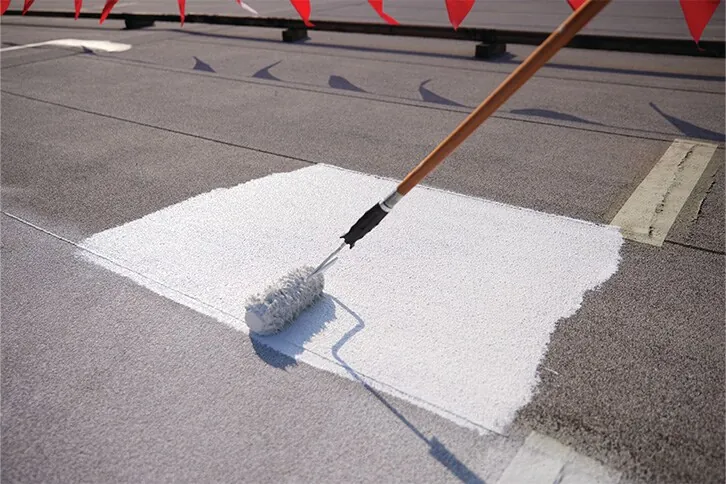
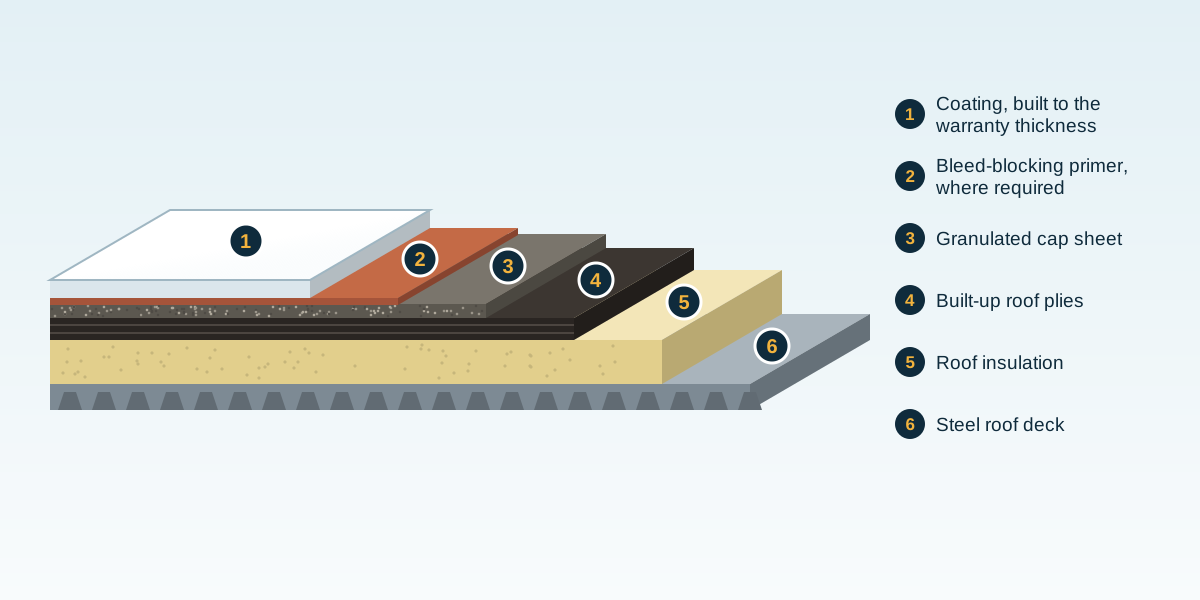
Modified bitumen roof restoration renews the surface of an asphaltic roof without tearing it off. The same approach works on built-up roofs (BUR), the multi-ply asphalt roofs found on many older commercial buildings. Wet areas are cut out and replaced, the roof is cleaned and primed, cracks, laps and flashings are reinforced, and a GAF silicone or acrylic coating goes over the top.
Restoration starts at $2.50 per square foot in Houston, typically about a third of the cost of a new roof, and it avoids hauling a heavy asphalt roof off the building. GAF lists both smooth and granulated asphaltic roofs among the surfaces its coatings restore.
What Goes Wrong on Asphaltic Roofs
Asphalt roofs age from the surface down. Under the Houston sun, the top of the roof weathers first:
- Alligatoring: a pattern of surface cracks that looks like reptile skin
- Granule loss on mod-bit cap sheets, leaving bare asphalt exposed to UV
- Open laps and split seams between sheets
- Blisters and soft spots, which can mean trapped moisture
- Failing flashings at walls, curbs and drains
If the plies underneath are still intact and the insulation is dry, those are surface problems a coating system can fix. If the survey finds saturated insulation or failed plies across the roof, it's a replacement.
The Asphalt Bleed-Through Problem
Asphalt contains oils that can migrate up into a coating and stain or soften it. Every asphaltic restoration has to deal with that before the white coating goes on, and GAF's systems handle it in different ways:
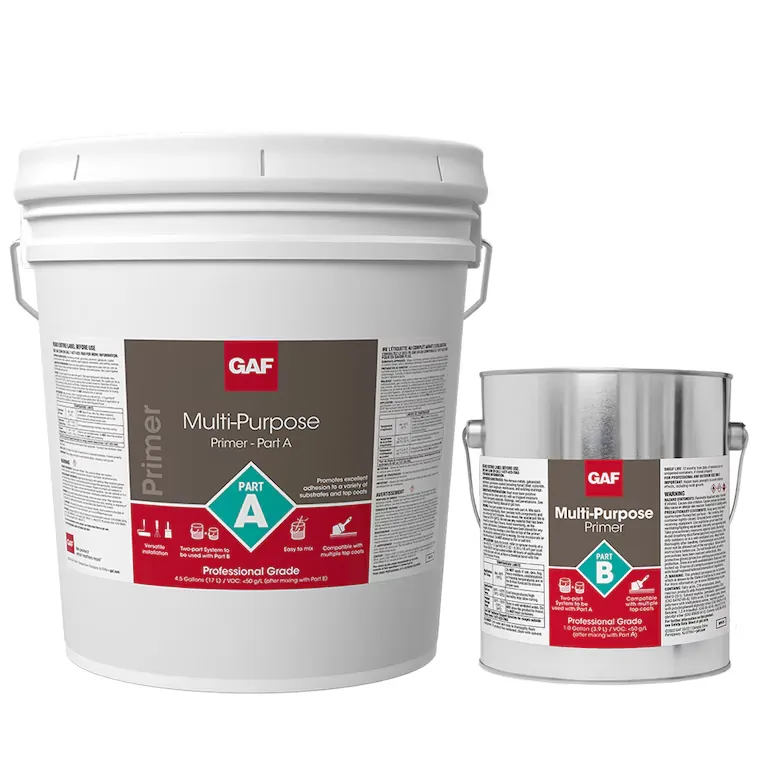
- Silicone over asphaltic: a bleed-blocking primer first. GAF specifies its Multi-Purpose Primer at 0.66–1.0 gallons per square on smooth surfaces and 1.0–1.3 on granulated surfaces, because granules soak up more.
- Acrylic over asphaltic: a GAF Acrylic Base Coat, which improves adhesion of the top coat and helps mitigate bleed-through.
- Urethane: manufacturer data sheets describe aromatic urethane base coats as resisting oil migration from asphalt-based roofs. See urethane roof coating.
Gravel-surfaced built-up roofs are a special case. The Roof Coatings Manufacturers Association notes that ballasted and gravel-surfaced roofs aren't normally acceptable surfaces for coating without special treatment, so the loose gravel has to be dealt with first. We'll tell you after the survey what that means for your roof and its price.
How the Restoration Runs
GAF's published steps for asphaltic roofs:
- Qualify: the roof clean, dry and tight; a moisture scan to identify every wet area; adhesion tests.
- Prepare: wet membrane and insulation replaced with like material, then the roof power washed.
- Prime or base coat: the bleed-blocking primer (silicone) or base coat (acrylic).
- Detail: tight seams sealed; loose seams three-coursed with mastic or flashing and 6-inch fabric; alligatored areas, curbs, penetrations and drains reinforced with 12-inch fabric.
- Coat: the field coat at the rate specified for the warranty term.
Silicone or Acrylic Over Mod-Bit and BUR?
| GAF system over asphaltic | Terms GAF specifies | Suits |
|---|---|---|
| Silicone (Unisil or high-solids silicone) | 10, 15 or 20 years | Flat roofs with ponding water; the longest terms |
| Acrylic base coat + top coat | 10 or 15 years | Roofs that drain well; moderate restoration at a lower cost |
More detail on silicone, acrylic and the GAF coating warranty. For a ballpark price, try the roof coating cost calculator.
Sources: GAF silicone over asphaltic · GAF acrylic over asphaltic · Roof Coatings Manufacturers Association FAQs.
Modified Bitumen Roof Restoration FAQ
Yes, when the plies are intact and the insulation is dry. GAF's systems restore both smooth and granulated asphaltic roofs. The roof is primed or base coated first so asphalt oils don't bleed through the coating.
Coating a commercial roof in Houston typically runs about $2.50 to $4.50 per square foot, compared with $8 to $16 per square foot to replace it. Wet areas to replace, the primer needed on a granulated surface and the warranty term affect where a mod-bit or BUR roof lands.
Not as it is. The Roof Coatings Manufacturers Association notes that ballasted and gravel-surfaced roofs are not normally acceptable surfaces for coating without special treatment, so the loose gravel has to be dealt with first. The survey tells us what your roof needs.
Asphalt contains oils that can bleed up into a white coating and stain or weaken it. For silicone, GAF calls for a bleed-blocking primer; for acrylic, a GAF acrylic base coat helps mitigate the bleed-through.
Alligatoring is a pattern of cracks across the surface of an asphalt roof that looks like reptile skin, caused by the asphalt drying out and shrinking in the sun. GAF's acrylic-over-asphaltic steps treat alligatored areas with flashing and fabric before the roof is coated.
Have a cracked mod-bit or built-up roof? Call (832) 224-3435 or request a free roof survey.